
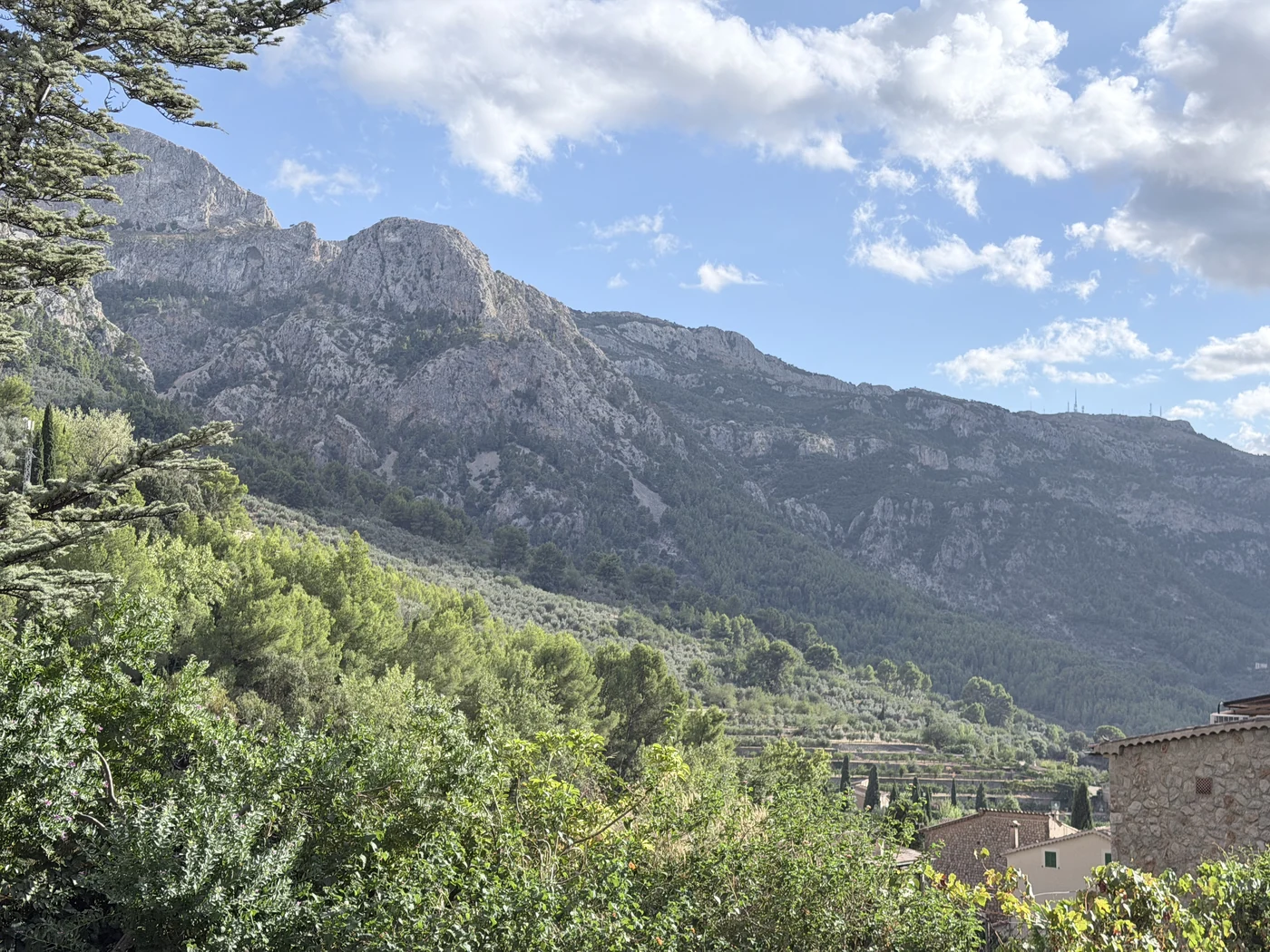
Sóller and Port de Sóller are two places, but they are hard to think of separately. One lies in the valley basin between the mountains, in the middle of the orange groves. The other lies a good three kilometres further on at the water, in an almost circular bay. A tram has run between them for more than a hundred years. Anyone who walks across the square in Sóller in the morning and sits by the harbour in the evening has not taken two separate outings, but experienced a single day that slowly moves from the mountains down to the sea.
Sóller and the Tramuntana
What defines Sóller is visible before you even reach the town. The Serra de Tramuntana stands all around it like a wall. Grey and bare at the top, green on the slopes, and between them the terraces that people built into the rock a very long time ago. For centuries the valley was hard to reach. Anyone coming from Palma had to cross the mountains or arrive by boat. The railway only came in 1912, the tunnel in 1997.
That seclusion preserved the character of the town for a long time. Sóller does not feel like a holiday resort that has dressed itself up for its guests. There are streets where ordinary life simply goes on, there are small shops, and sometimes that scent of oranges really does hang in the air. The oranges from the valley of Sóller were once one of the most important goods in the trade with France.
Houses that catch the eye
With the orange trade came money into the valley, and with the money came architecture. Many families from Sóller went to France, grew wealthy there and, after returning, built houses of a kind you rarely see elsewhere on Mallorca. Catalan Modernisme shaped whole facades here, curved window frames, wrought iron balconies, stonework that took its time.
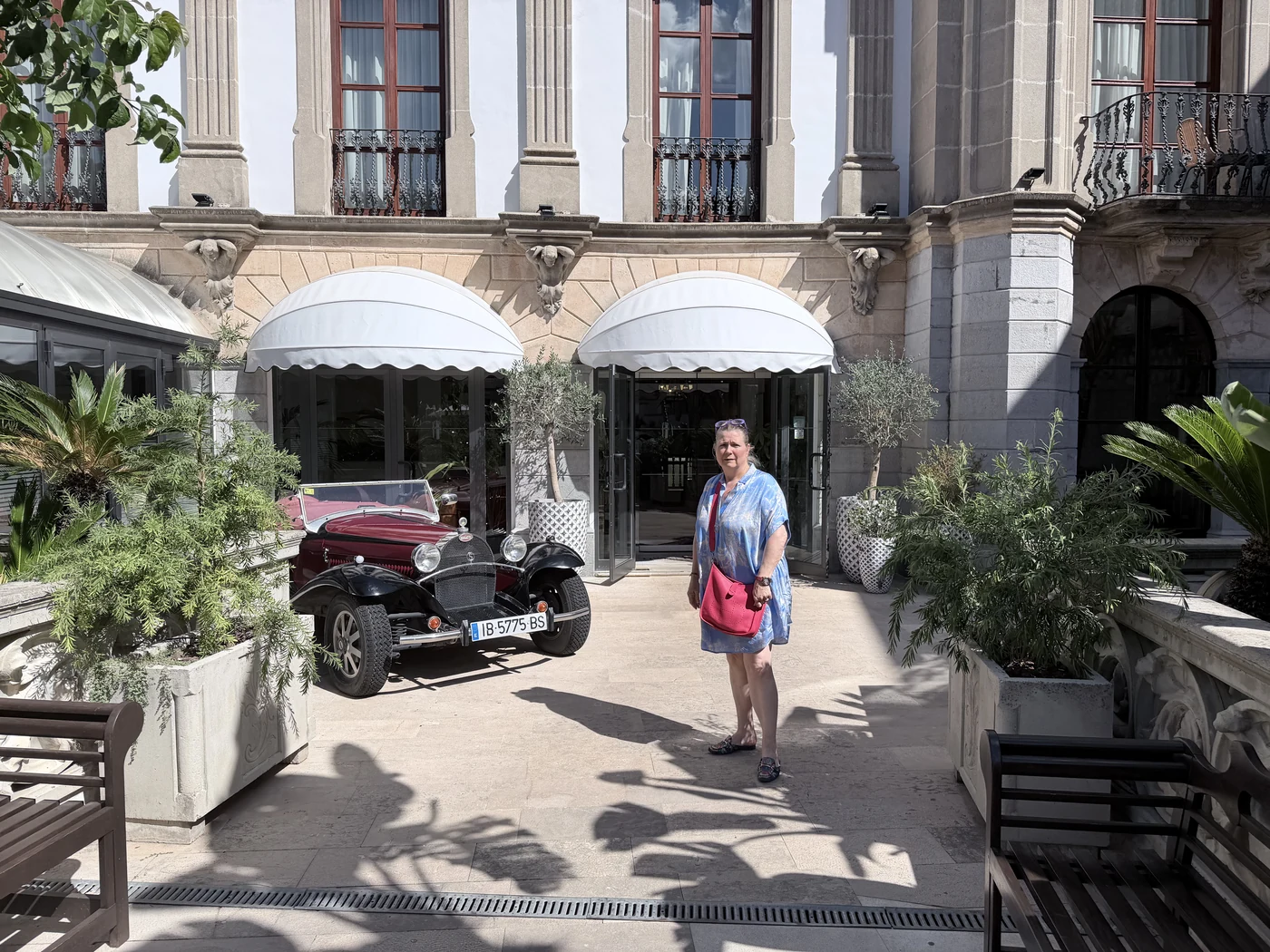
The Gran Hotel Sóller is one of those houses that simply make you stop. It was originally built at the beginning of the twentieth century as a family home and is a hotel today. The facade is strict and playful at the same time, and on that day an old car stood in front of it, parked there as naturally as if it belonged to the house.
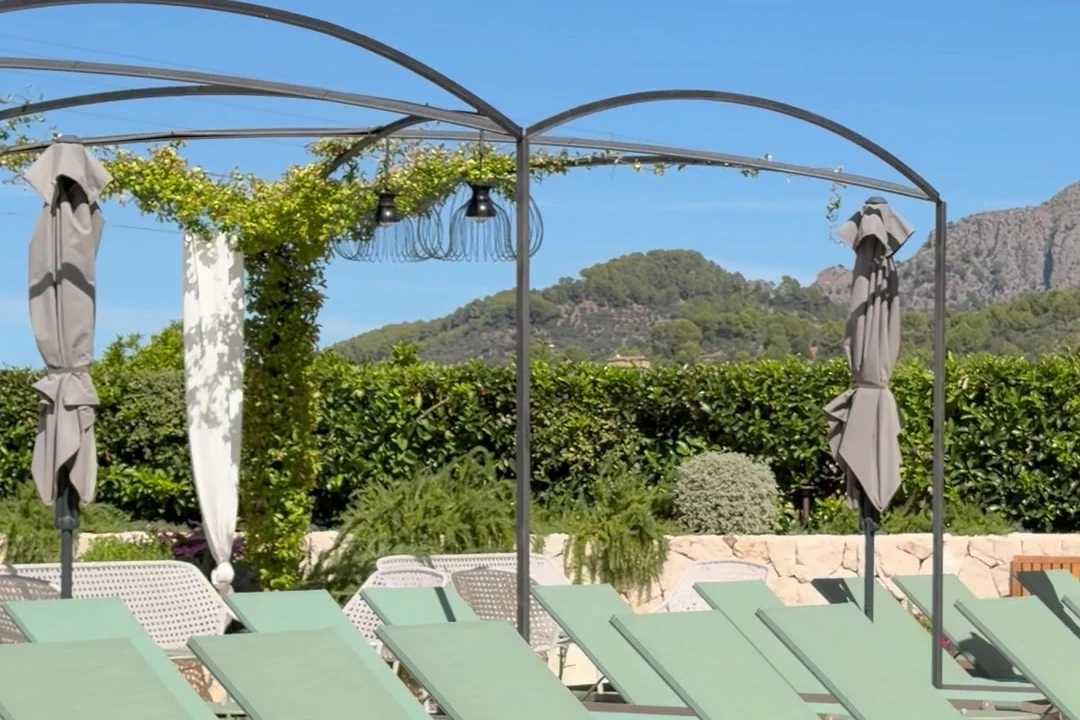
A little further on lies the Hotel Alcázar, another of these houses from the good years of the valley. We only went in for a look. What I liked there was the terrace behind the building. A light pergola, loungers in a muted sage green, a high hedge, and behind it the Tramuntana again. It quickly becomes clear why so many of these houses in Sóller have kept their character.
A view across Sóller
The valley is best understood from above. We were able to take in the view from the roof terrace of our friends in Sóller, and from up there you can see how the town is actually built. A dense field of ochre tiled roofs, the towers of the church of Sant Bartomeu among them, and behind it the mountains rising without leaving a gap anywhere.
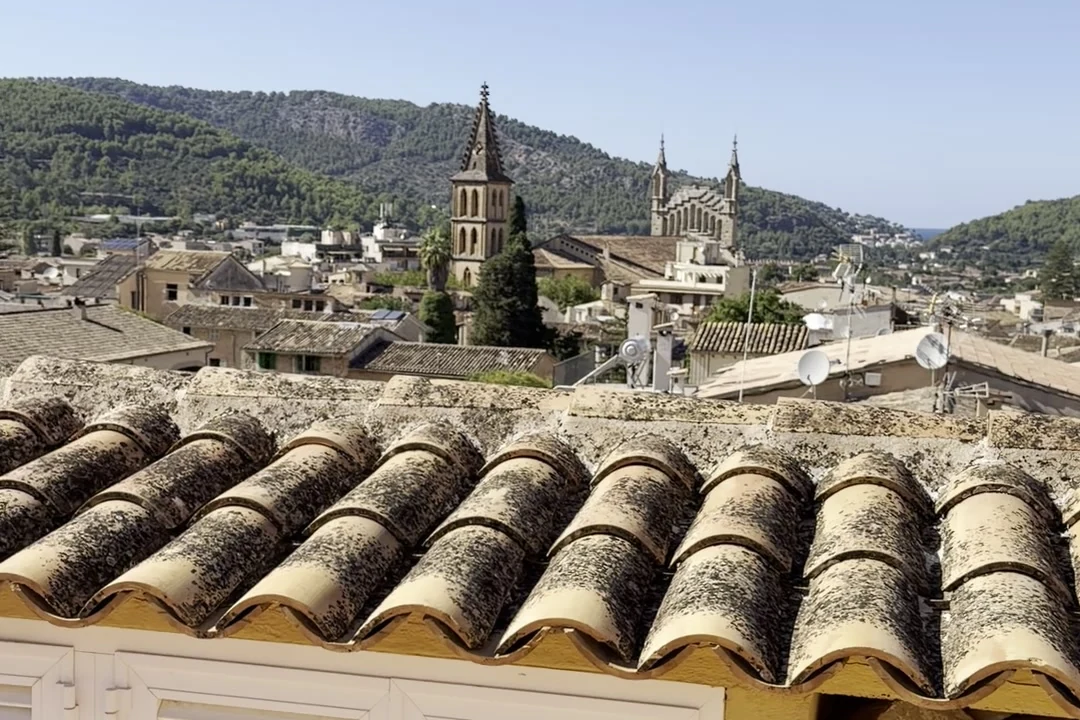
That is the moment when you understand why the people here kept to themselves for so long. The valley is closed. It has exactly one opening, and that one leads to the sea.
Port de Sóller
This opening ends in a bay that is almost a closed circle. For a long time Port de Sóller was purely a fishing harbour, and the shape of the bay explains why. The water stays calm here even when there is wind outside. Today boats and small yachts lie side by side, in the evening everyone on the promenade walks in the same direction, and the light over the water grows softer the later it gets.
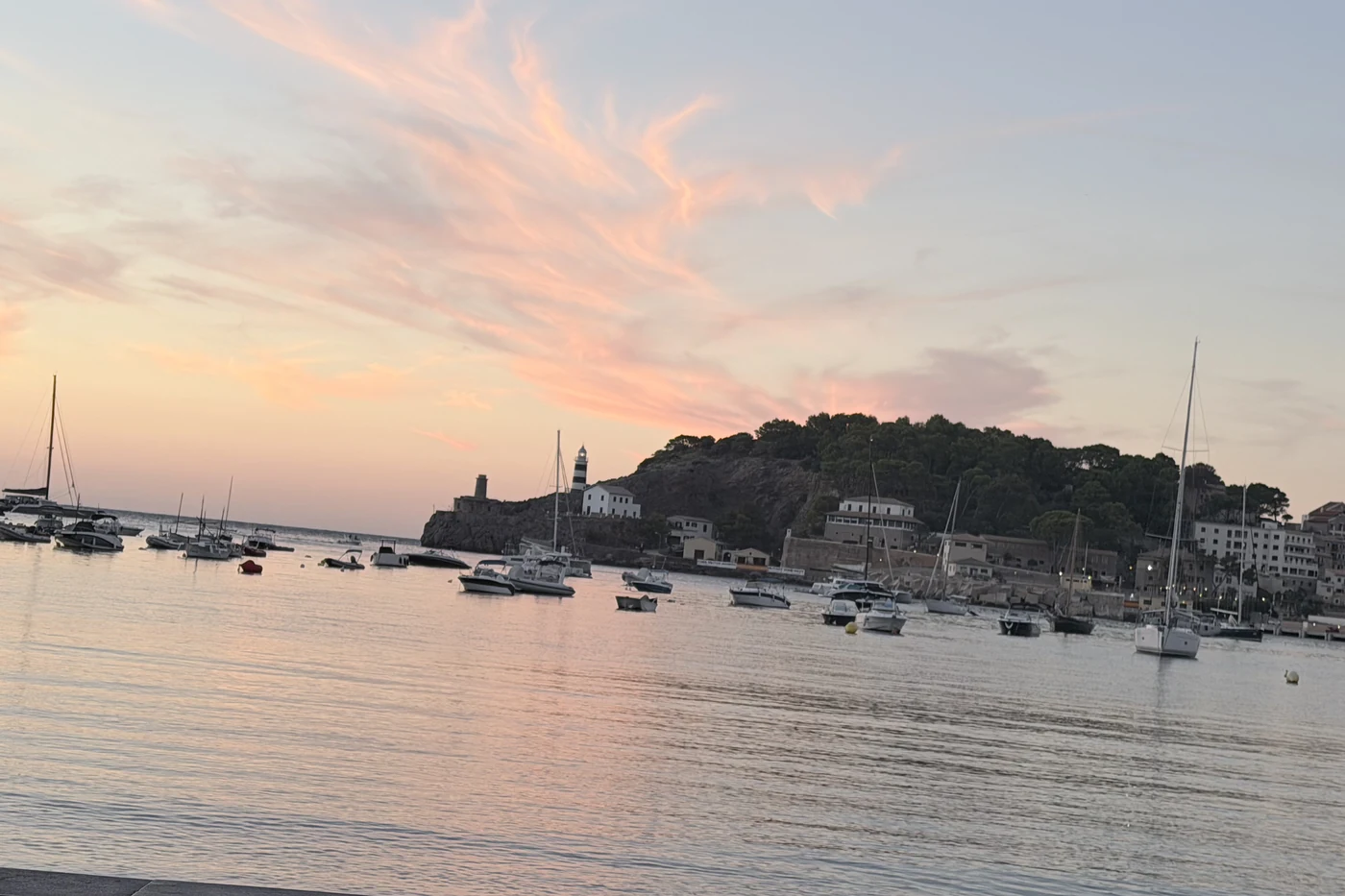
We were here on several evenings. Once down at the water at Es Passeig right on the promenade, and once up on the slope at the Nautilus with the view across the whole bay. For me both belong to this harbour, and each one tells a different side of it.
A stop at the Bikini Hotel
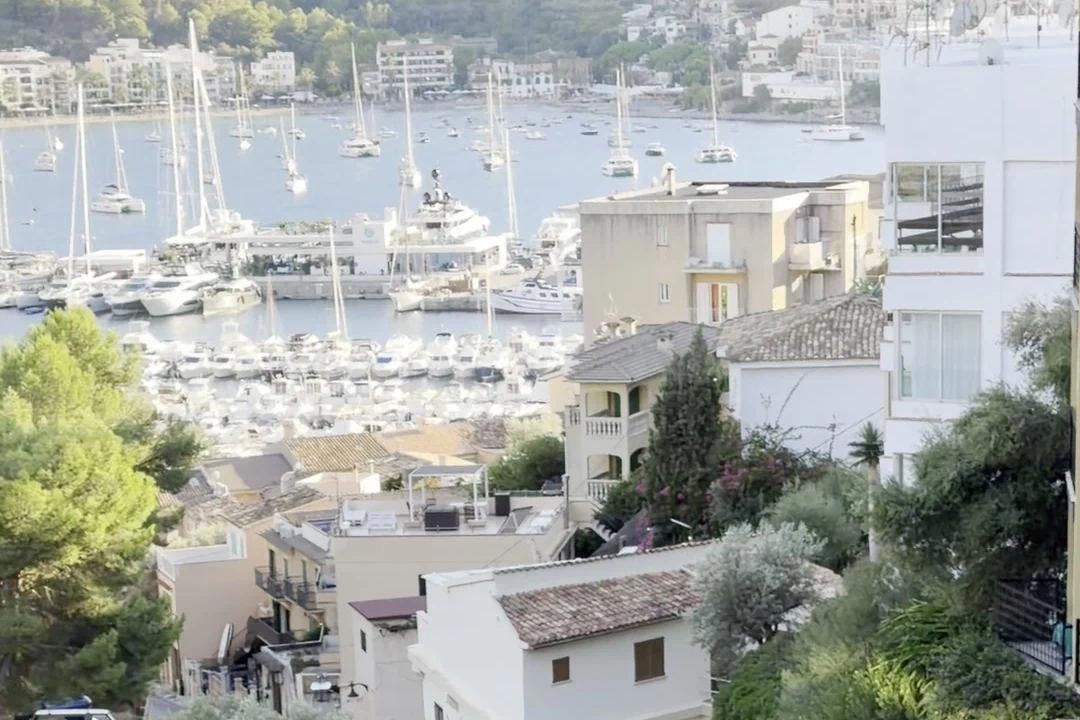
Halfway up above the harbour lies the Bikini Hotel. We were only there briefly, for the view and for the design. A lot of wood, muted colours, clear shapes. Nothing distracts from the view. And that view is the real reason to go up there. From the terrace, the whole bay opens out below you.
Towards Fornalutx
Driving on from Sóller, you reach Fornalutx after a few minutes. The road follows the slope, past olive terraces and isolated stone houses, with the ridge of the Tramuntana rising above it all. It grows quieter with every bend.
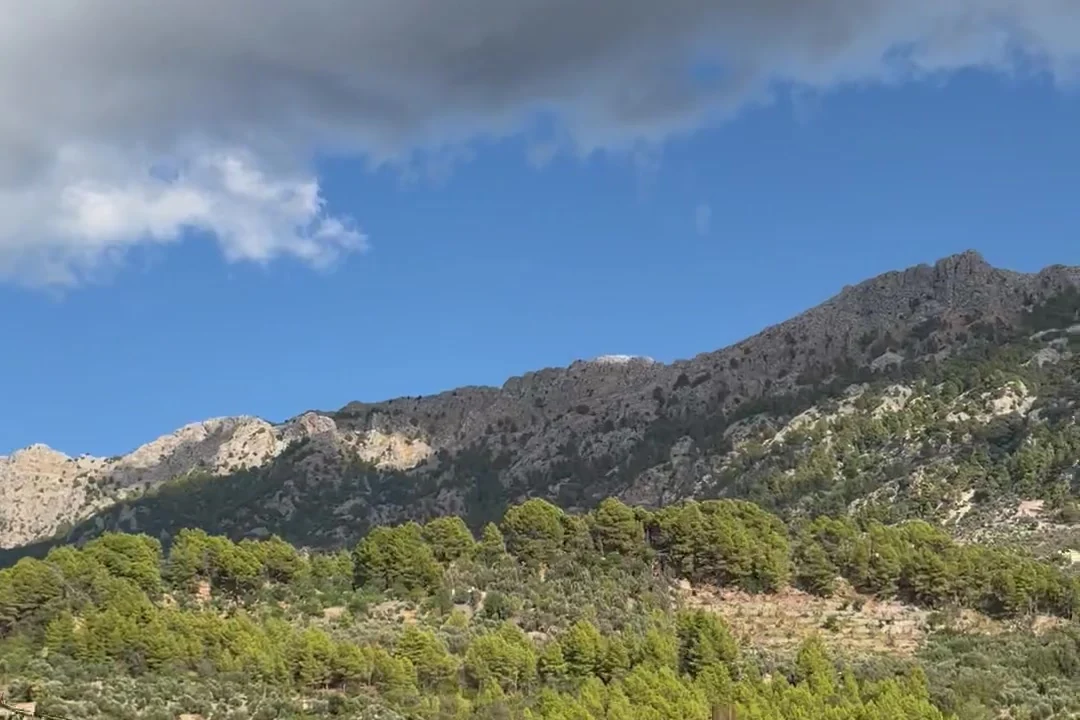
That is exactly what I love about this corner of Mallorca. You do not need a long journey to get from the harbour into the mountains. A few bends are enough, and the sea is nothing more than a memory from ten minutes ago.


